CIDR vs Private IP vs Public IP Address — Complete Guide
Understand the differences between CIDR, Private IP, and Public IP Address with real-world examples and AWS use cases. A must-know guide for developers and cloud engineers.

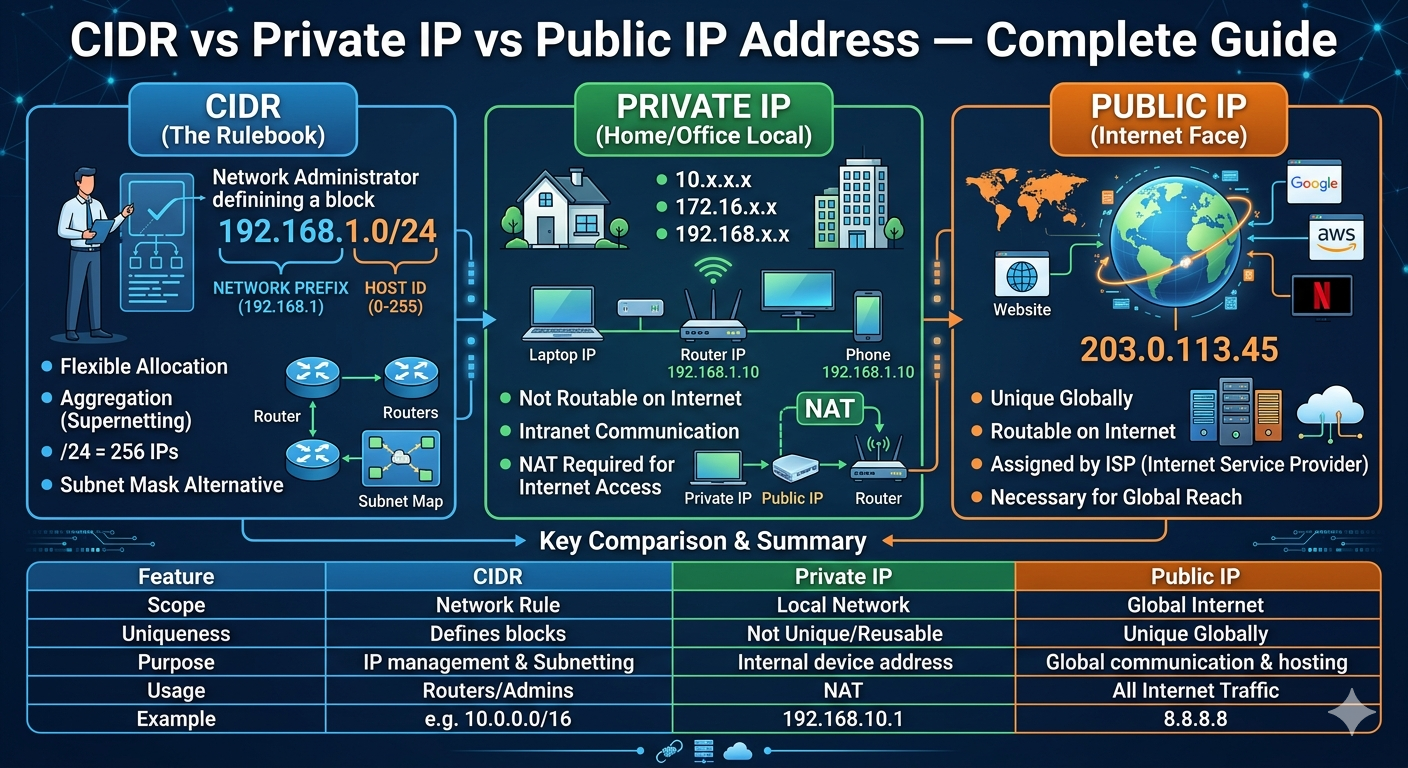
CIDR vs Private IP vs Public IP Address — Complete Guide
When working with cloud platforms like AWS, Docker, or any distributed system, understanding networking basics is non-negotiable. Three core concepts you’ll encounter everywhere are CIDR, Private IP, and Public IP Address.
Let’s break them down in a simple and practical way.
What is a Public IP Address?
A Public IP Address is an IP that is exposed to the internet. It is globally unique and assigned by an ISP.
Key Points:
- Accessible from anywhere on the internet
- Required for hosting websites or APIs
- Must be unique across the globe
Example:
8.8.8.8
142.250.183.206
Real-world Use:
When you visit a website, your request goes to a server’s public IP.
What is a Private IP Address?
A Private IP Address is used inside a local or internal network. These IPs are not directly reachable from the internet.
Private IP Ranges:
10.0.0.0 – 10.255.255.255
172.16.0.0 – 172.31.255.255
192.168.0.0 – 192.168.255.255
Key Points:
- Used for internal communication
- Can be reused in different networks
- Not accessible from the internet
Example:
192.168.1.10
10.0.0.5
Real-world Use:
Devices in your home Wi-Fi or AWS VPC communicate using private IPs.
What is CIDR?
CIDR (Classless Inter-Domain Routing) is a method to define a range of IP addresses.
Format:
IP_ADDRESS / PREFIX
Example:
192.168.1.0/24
This means:
- Total IPs: 256
- Usable IPs: 254
The /24 indicates how many bits are reserved for the network.
CIDR Quick Table
| CIDR | Total IPs | Usable IPs |
|---|---|---|
| /32 | 1 | 1 |
| /30 | 4 | 2 |
| /24 | 256 | 254 |
| /16 | 65,536 | 65,534 |
Key Differences
| Feature | Public IP | Private IP | CIDR |
|---|---|---|---|
| Scope | Internet | Local Network | Defines IP range |
| Accessibility | Public | Private | Depends on configuration |
| Uniqueness | Global | Local reuse | Not applicable |
| Example | 8.8.8.8 | 192.168.1.1 | 192.168.1.0/24 |
How They Work Together (AWS Example)
Let’s say you create an AWS setup:
- VPC CIDR:
10.0.0.0/16 - Subnet CIDR:
10.0.1.0/24
Instance:
- Private IP →
10.0.1.10 - Public IP →
54.x.x.x
Flow:
- Internal communication → Private IP
- External access → Public IP
- Network size → Defined by CIDR
Easy Analogy
Think of it like an apartment:
- Public IP → Building address
- Private IP → Flat number
- CIDR → Total flats in building
Interview Tips
- Private IP + NAT → Internet access
- CIDR decides subnet size
- Public IP required for external exposure
Final Thoughts
- Public IP = Internet identity
- Private IP = Internal communication
- CIDR = Network structure