VPC Peering vs Transit Gateway — Complete AWS Networking Guide
Understand the differences between VPC Peering and Transit Gateway in AWS with real-world use cases, architecture patterns, and best practices. A must-know guide for scalable cloud networking.

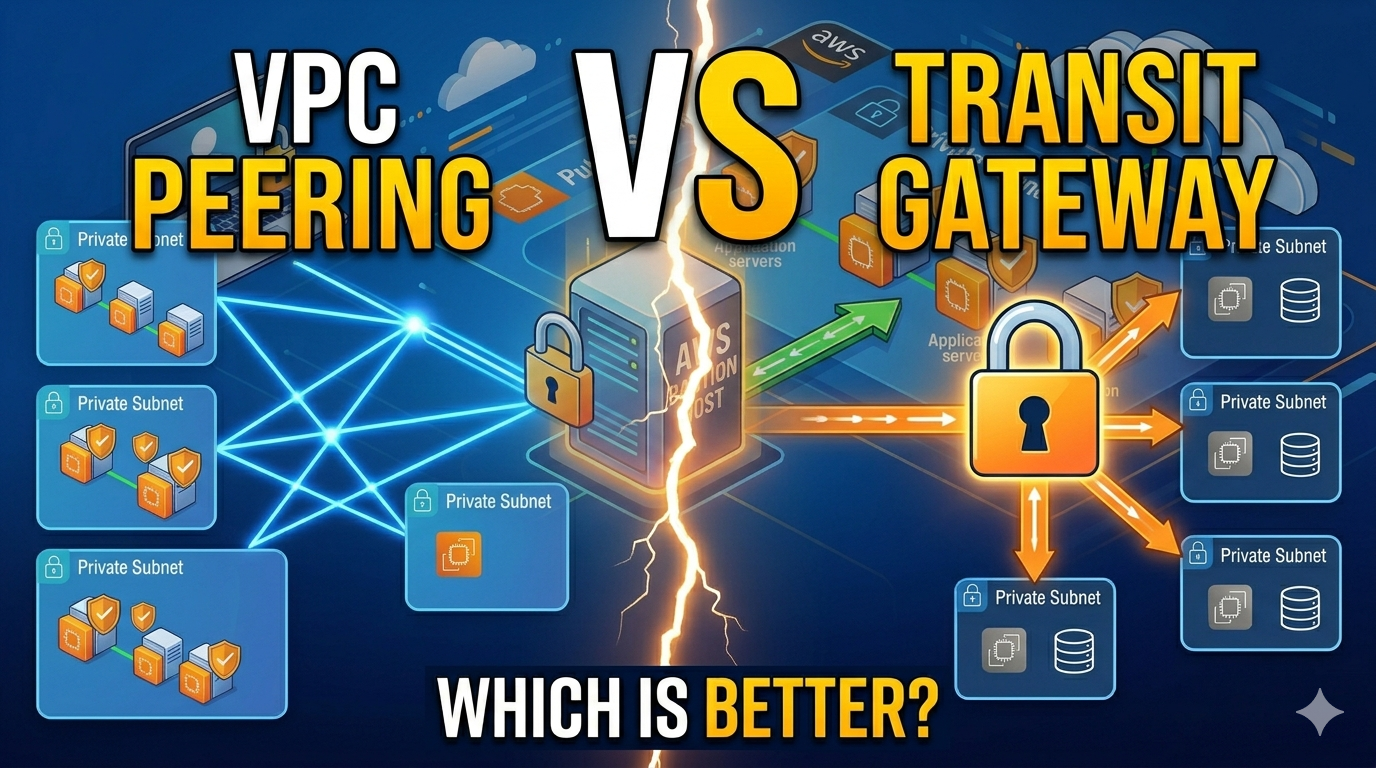
VPC Peering vs Transit Gateway — Complete Guide
When designing scalable AWS architectures, connecting multiple VPCs is a common requirement. Two major approaches are VPC Peering and Transit Gateway.
Both solve the same problem — VPC-to-VPC communication — but in very different ways.
Let’s break it down clearly.
What is VPC Peering?
VPC Peering is a direct one-to-one connection between two VPCs that allows them to communicate privately using internal IP addresses.
Key Idea:
Simple, direct, and point-to-point connection.
VPC A ←→ VPC B
What is Transit Gateway?
A Transit Gateway acts as a central hub that connects multiple VPCs and on-premise networks.
Key Idea:
Hub-and-spoke model for large-scale networking.
        VPC A
          |
VPC B — Transit Gateway — VPC C
          |
        VPC D
Why Do We Need Transit Gateway?
As your system grows:
- Managing many VPC Peerings becomes complex
- Number of connections increases rapidly
- Routing becomes difficult
Problem with Peering:
If you have 5 VPCs → you need 10 peering connections
Solution:
Use a Transit Gateway to simplify architecture.
Key Differences
| Feature | VPC Peering | Transit Gateway |
|---|---|---|
| Connection Type | One-to-One | Hub-and-Spoke |
| Scalability | Limited | Highly Scalable |
| Routing | Manual | Centralized |
| Transitive Routing | ❌ Not Supported | ✅ Supported |
| Complexity | Simple | Moderate |
| Cost | Lower | Higher |
Real-world Example
Scenario:
You have:
- Dev VPC
- Staging VPC
- Production VPC
- Shared Services VPC
Using VPC Peering:
- Many connections required
- Hard to manage
Using Transit Gateway:
- All VPCs connect to one central hub
- Easy routing and management
When to Use What?
Use VPC Peering when:
- You have few VPCs (2–3)
- Simple architecture
- Low cost requirement
Use Transit Gateway when:
- You have many VPCs
- Need centralized control
- Large-scale production system
Important Concepts
1. No Transitive Peering
In VPC Peering:
A → B and B → C ≠ A → C
2. CIDR Restriction
- CIDR blocks must not overlap (in both cases)
Best Practices
- Plan CIDR ranges carefully
- Use Transit Gateway for enterprise-level systems
- Keep route tables organized
- Monitor network traffic
Simple Analogy
Think of transportation:
- VPC Peering → Direct road between two cities
- Transit Gateway → Central highway hub connecting many cities
Final Thoughts
- VPC Peering is simple and cost-effective
- Transit Gateway is powerful and scalable
Choosing the right one depends on your system size and future growth.