What is VPC Peering? — Complete Guide for AWS Networking
Learn what VPC Peering is, why it is used, and how it enables secure communication between VPCs in AWS. A complete guide with real-world examples and best practices.

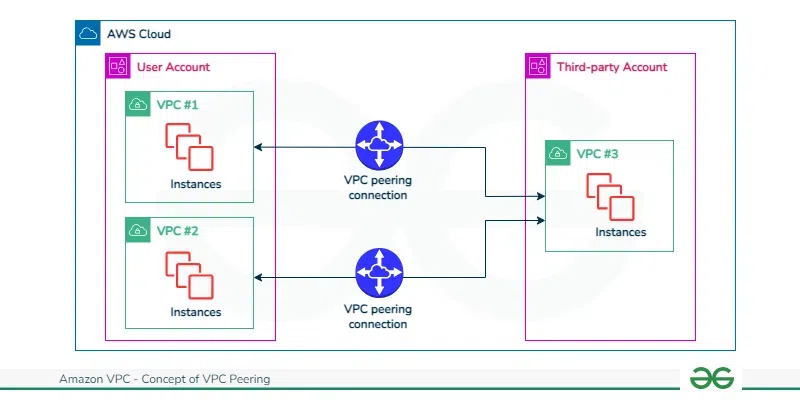
What is VPC Peering? — Complete Guide
When building scalable cloud systems in AWS, you often end up with multiple VPCs. But how do these VPCs communicate securely with each other?
That’s where VPC Peering comes in.
What is VPC Peering?
VPC Peering is a networking connection between two VPCs that allows them to communicate with each other privately using their private IP addresses.
Key Idea:
It creates a direct private connection between two VPCs without using the public internet.
Why Do We Need VPC Peering?
In real-world systems, you may have:
- Separate VPCs for dev, staging, and production
- Different services running in different VPCs
- Microservices split across multiple VPCs
Problem:
By default, VPCs cannot communicate with each other.
Solution:
Use VPC Peering to enable secure communication.
How VPC Peering Works
Architecture Flow:
VPC A ←→ VPC B
- Traffic flows privately using internal IPs
- No internet gateway involved
- No NAT required
Real AWS Example
Setup:
VPC A:
- CIDR →
10.0.0.0/16 - App Server →
10.0.1.10
VPC B:
- CIDR →
192.168.0.0/16 - Database →
192.168.1.10
Flow:
- App server in VPC A connects to DB in VPC B via private IP
- Traffic stays within AWS network
Steps to Configure VPC Peering
- Create Peering Connection
- Accept the request (if cross-account)
- Update Route Tables in both VPCs
- Configure Security Groups
Route Table Example
In VPC A:
Destination: 192.168.0.0/16 → Target: Peering Connection
In VPC B:
Destination: 10.0.0.0/16 → Target: Peering Connection
Advantages of VPC Peering
- Private communication
- Low latency
- No bandwidth bottleneck
- Simple to set up
Limitations of VPC Peering
❌ No transitive peering (A → B and B → C does NOT mean A → C)
❌ CIDR blocks must not overlap
❌ Hard to manage at scale (many VPCs)
VPC Peering vs Other Options
| Feature | VPC Peering | Transit Gateway |
|---|---|---|
| Connectivity | One-to-One | Hub-and-Spoke |
| Scalability | Limited | Highly scalable |
| Complexity | Simple | Moderate |
Best Practices
- Use non-overlapping CIDR blocks
- Keep route tables clean
- Use tagging for clarity
- Monitor traffic flow
Simple Analogy
Think of two offices:
- VPC Peering → Private tunnel between two offices
- No need to go through public roads (internet)
- Secure and direct communication
Final Thoughts
VPC Peering is a powerful and simple way to connect VPCs:
- Direct private connection
- No internet exposure
- Ideal for small to medium architectures